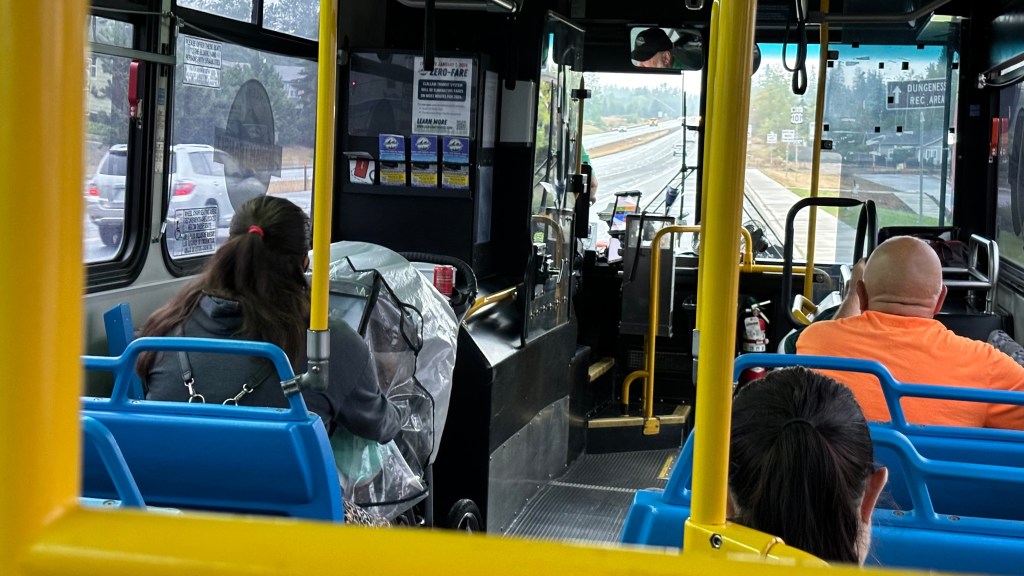
May 12, 2025 — Today Governor Bob Ferguson signed into law HB 1418 [1] which adds two voting members who are transit users to the governing body of public transportation benefit areas. This law amends Washington state law to allow PTBAs to appoint two voting members to their governing boards, one who is transit-reliant and one from an organization that serves transit-reliant communities.
Twenty-one out of Washington State’s transit agencies are governed under the PTBA structure. By Washington State Law, these transit agency boards are composed of locally elected officials, many of which don’t often ride transit. While many transit agencies support citizen advisory committees (CACs) for community member input, there is no assurance that community feedback will be incorporated into decision-making.
“For people who can grab their keys and drive where they need to go, transportation isn’t a major concern. But for those of us who can’t drive or can’t afford to, transportation access is something we think about daily [2]. We care deeply about how transit works because it is such a major part of our day and can make the difference between getting to do the things that connect us to our communities, like running errands, seeing a friend, or getting to an appointment. Without functional transit, we can be stuck at home—or, if we’re lucky, reliant on a friend or family member having time to drive us,” said Anna Zivarts, director of the Disability Mobility initiative at Disability Rights Washington.
Representative Joe Timmons led the effort to pass this legislation. “I think it’s so important that we let folks who most use transit services have a seat at the table in making these important decisions,” Rep. Timmons explained. “I believe that transit riders have a unique perspective, lived experience and expertise that they can bring to these important decision-making processes.”
On the Senate floor, Senator Liz Lovelett shared that her experience during Week Without Driving [3] led to her championing this bill. “Having representation on local boards [from people] that have lived experience are crucial in providing these recourses and services to the community,” she explained.
Transit advocates were inspired by the fact that community representatives have served on Thurston County’s Intercity Transit’s governing board since the PTBA law was amended in 1982 to grant Intercity Transit’s board this privilege.
“Intercity Transit Authority has benefited greatly from the experience and insight of community representatives as voting members of our board. I’m excited that this bill will create more opportunity for system users to participate in guiding public transit across Washington,” said Clark Gilman, Olympia City Council and former Chair Intercity Transit Authority.
Not only have these community representatives been key in guiding Intercity Transit through the budget crises brought on by Tim Eyman’s initiatives in the early 2000s, these positions also opened careers in transportation [4] for people who wouldn’t otherwise felt they belonged, including Joan Cullen. She would launch Washington State’s Transportation Demand Management program in the 1990s and came to transportation through serving as a community representative on the Intercity Transit Board.
“Most of our board members are not frequent transit riders. We recognize the direct stake that riders have in public transit, and Clallam Transit’s board discussed adding rider representation but decided against it because current Washington State law isn’t clear about whether this would be a properly constituted transit board,” said Lindsey Schromen-Wawrin, a Clallam Transit board member and Port Angeles City Councilmember since 2018.
“Because many on transit boards tend to be car drivers, they really haven’t internalized what it means to be a transit rider. Those decisions determine whether you as a transit rider are going to be able to keep a job, going to be able to continue to be a caregiver, going to be able to continue to go to school,” shared Judy Jones, a blind advocate and long-term member of Skagit Transit’s Community Advisory Committee.
“The bill’s passing illustrates what ‘Nothing About Us Without Us’ should look like. Those most impacted by the system should have a seat at the decision-making table. We as people with disabilities can finally have a say about what happens in the transit systems we use regularly,” said Amin Hester from the Alliance for Accessibility Tacoma.
“There is no better champion for high quality transit service than someone who uses that service on a regular basis. Spokane Reimagined applauds the legislature and Governor Ferguson in making this proposal law and we encourage every eligible agency to take advantage of this opportunity when the law goes into effect,” shared Spokane Reimagined Erik Lowe.
Disability Rights Washington is putting together a training program and convening for transit riders from across the state who live in communities where transit is provided by PTBA governed transit agencies. Those agencies include: Whatcom Transit, Valley Transit, Twin Transit, TranGo, Skagit Transit, Spokane Transit, RiverCities Transit, Pierce Transit, Pacific Transit, Mason Transit, Lewiston/Asotin County Transit, Link Transit, Kitsap Transit, Jefferson Transit, Island Transit, Grant Transit, Garfield County Transit, Community Transit, Columbia County Transit, Clallam Transit, C-TRAN, and Ben Franklin Transit.
If you’re someone who relies on transit in one of these areas, please email us [5] to learn more.
The law goes into effect January 1, 2026.