
AVID - Amplifying Voices of Incarcerated Individuals with Disabilities

Cruel But Not Unusual
November 2016
Solitary confinement in Washington’s county jails disproportionately affects people with disabilities. Many jails go so far as to place inmates with disabilities in solitary confinement because of their disability. “Cruel but Not Unusual: Solitary Confinement in Washington’s County Jails” describes the harmful effects of solitary confinement on people with disabilities, provides overview of the disproportionate and discriminatory placement of people with disabilities in solitary confinement in Washington’s county jails, and identifies best practices and recommendations for reform.

Prescription for Change
October 2016
“Prescription for Change: Access to Medication for People with Disabilities in Jail” finds that our county jails often delay, disrupt or deny necessary prescription medication to people in their care. Prescription medication is a common and vital part of medical and mental health care for many people, including people with disabilities. By continuing to make it difficult or impossible for people to access necessary medication, Washington State’s jails risk violating the law and, more importantly, causing serious harm and even death.
You Can’t Just “Tell”
September 2016
“You Can’t Just “Tell”: Why Washington Jails Must Screen for Mental Illness and Cognitive Disabilities” pinpoints the need for screening and early identification of inmates with disabilities to allow jails to provide legally-required services and reasonable accommodations and to maintain safety for all inmates and jail staff.

Locked Up and Locked Down
September 2016
“Locked Up and Locked Down: Segregation of Inmates with Mental Illness” describes how between 80,000 and 100,000 inmates are currently segregated in prison cells nationwide for 22-24 hours per day, for days, months, years, and in some cases decades at a time. Segregation disproportionately affects inmates with mental illness and research shows that individuals may acquire symptoms of mental illness, or experience exacerbated symptoms of mental illness, as a result of the conditions in segregation.
Locked Up and Locked Down: Segregation of Inmates with Mental Illness
September 8, 2016Between 80,000 and 100,000 inmates are currently segregated in prison cells nationwide for 22-24 hours per day, for days, months, years, and in some cases decades at a time. Segregation disproportionately affects inmates with mental illness and research shows that individuals may acquire symptoms of mental illness, or experience exacerbated symptoms of mental illness, as a result of the conditions in segregation.New video: On The Outs
September 7, 2016On The Outs: Reentry for Inmates with Disabilities is a short documentary produced by the Amplifying Voices of Inmates with Disabilities (AVID) Prison Project.
The AVID Jail Project and SCORE
August 2016
“The AVID Jail Project and SCORE: Improving Conditions for Inmates with Mental Illness Through Collaboration” explains the ongoing successful collaboration between Disability Rights Washington’s AVID Jail Project and South Correctional Entity (SCORE), a jail in South King County, Washington. The cooperative relationship between Disability Rights Washington and SCORE has produced significant positive changes for inmates with disabilities and demonstrates a path forward for all of Washington’s jails.
The Need for Accessible Voting in Jail
August 2016
“The Need for Accessible Voting in Jail” report calls on county jails and election offices to help jail inmates participate in the upcoming election. The report follows an investigation Disability Rights Washington’s AVID Jail Project conducted into the policies and conditions in every county jail across the state that found the vast majority of jails do nothing to support inmate voting. Read more about accessible voting in Washington’s jails.
SCORE, DRW collaboratively improve conditions for inmates with mental illness
August 30, 2016DES MOINES – South Correctional Entity (SCORE), a multi-jurisdictional jail located in Des Moines, WA, has worked collaboratively with the AVID Jail Project of Disability Rights Washington since January 2015 to make swift and significant changes to improve conditions for inmates with mental illness.
Making Hard Time Harder
June 2016
As many as 31 percent of U.S. inmates in state prisons report having at least one disability. “Making Hard Time Harder: Programmatic Accommodations for Inmates with Disabilities Under the Americans with Disabilities Act” describes how inmates with disabilities often spend more time in prison, under harsher conditions, than inmates without disabilities.
Making Hard Time Harder: Programmatic Accommodations for Inmates with Disabilities Under the Americans with Disabilities Act
June 22, 2016As many as 31 percent of U.S. inmates in state prisons report having at least one disability. Inmates with disabilities often spend more time in prison, under harsher conditions, than inmates without disabilities.Forced Medication Behind Bars
June 14, 2016When the AVID Jail Project first began regularly visiting King County Correctional Facility (KCCF) last year, we had no idea that the jail was forcibly medicating some inmates.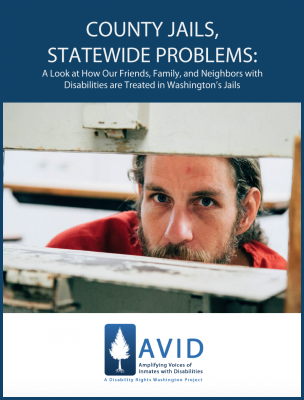
County Jails, Statewide Problems
April 2016
The high prevalence of disability in jail generates a requirement to meet the needs of numerous people with varying disabilities and medical conditions. Disability Rights Washington set out to investigate how well jails were doing in meeting the needs of people with disabilities. This report, “County jails, statewide problems: A look at how our friends, family and neighbors with disabilities are treated in Washington’s jails,” examines how friends, family, and neighbors with disabilities are treated in Washington’s jails.